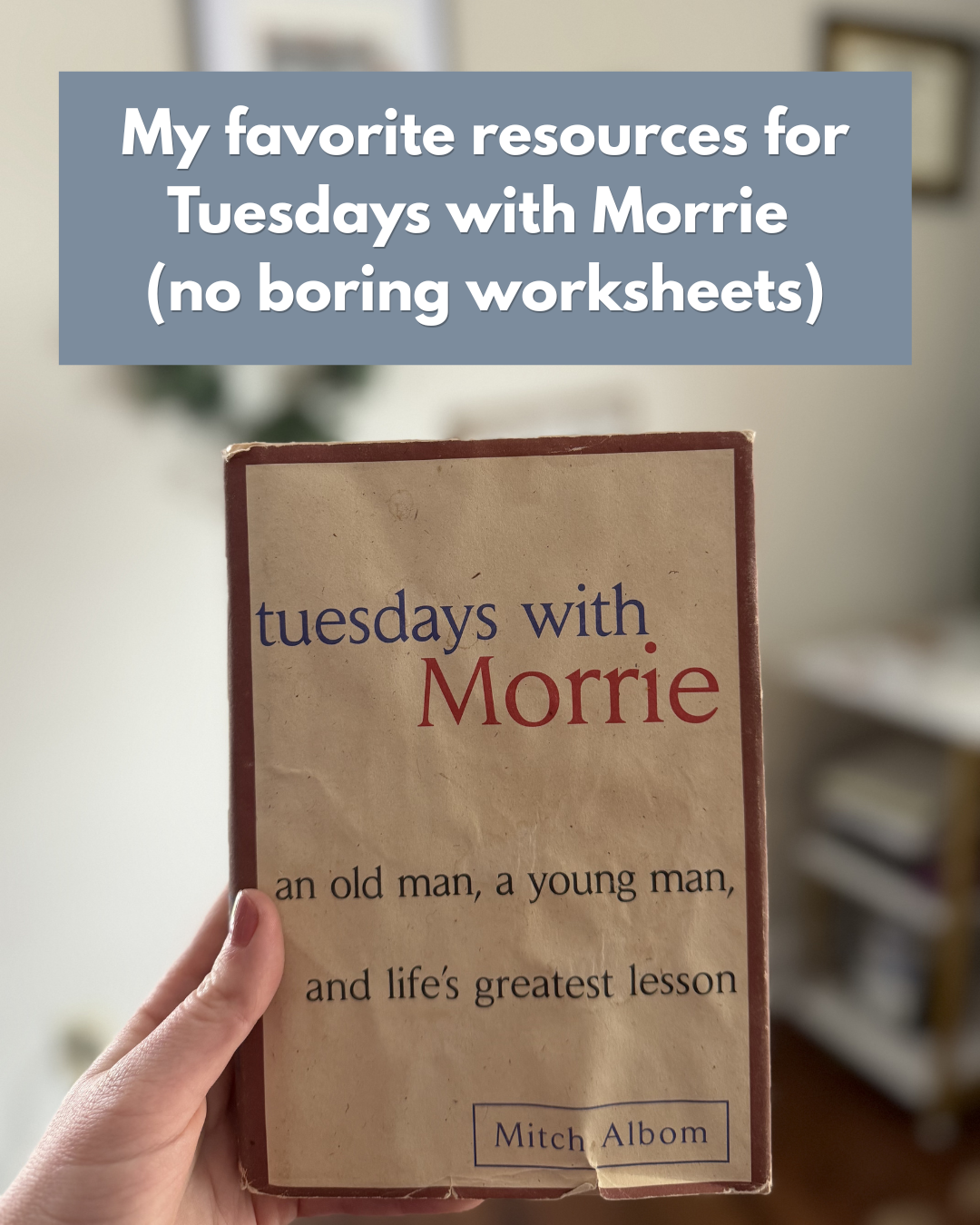
The first time I taught Tuesdays with Morrie, I was told the book taught itself. I used comprehension questions and discussion, but found that though students wanted to connect to it… they just didn’t know how.
They nodded along, said it was “sad” or “deep,” but getting them to really think critically, make connections, and engage in meaningful discussion was not at the level I wanted it to be.
After this first year teaching it, I spent hours revamping my unit to make it full of engaging and meaningful activities, projects, and resources. It’s been a favorite of mine to teach every year since!
So if you’re about to teach this novel or looking to refresh your approach, here are a few things that have worked really well in my classroom.
Tip #1: Start with Ideas, Not the Plot
Instead of jumping straight into the book, I like to start with big life questions that connect to the themes:
• How does the idea of death impact the way you live your life? Explain.
• How would your life change if you lost your mobility? If you are immobile, how do you find ways to move in nontraditional ways?
• What is your philosophy of life? In other words, what is your outlook on life what you want out of it? What goals do you have to lead you?
.
I usually do this through my Tuesdays with Morrie Introductory Reflective Learning Stations, and it immediately gets students thinking beyond just “what happens in the book.”

Tip #2: Don’t Just Read Aphorisms, Play With Them!
Morrie’s aphorisms are where so much of the depth lives, but students don’t always see that right away.
A few ways to make them stick:
• Have students explore what aphorisms are through an Aphorism Webquest.
• Run a Blind Aphorism Analysis Activity: In this activity, students will analyze important aphorisms out of context from Tuesdays with Morrie while still getting to move around the room. You will cut out and organize the provided aphorisms into envelopes for students to blindly choose and interpret on their own.
• Have students make their own Aphorism Bumper Stickers: Get creative and have students create their own aphorism bumper stickers for Morrie’s car using textual evidence, characterization, and symbolism.

Tip #3: Focus on Mitch (This Is Where the Depth Is)
A lot of students focus only on Morrie, but Mitch’s internal conflict is where the real analysis happens.
.
I like to ask:
• How is Mitch changing over time?
• What is he struggling with internally?
• Where do we see tension between who he is and who he wants to be?
.
When students start tracking this, their responses get so much stronger. I created a Tuesdays with Morrie Unit-Long Theme and Aphorism Tracker Analysis Activity for this purpose!
.

Tip #4: Build Writing in as You Go
One thing that helped my students a lot was not waiting until the end to write.
Instead:
• Quick responses tied to discussions
• Short evidence-based paragraphs
• Tracking themes and ideas as we read
.
In our Morrie’s Silhouette activity, students create different symbols to represent Morrie’s characterization before diving into a R.A.C.E.S. writing response that provides an opportunity for student choice. A few prompts include:
.
• How do your views about death compare with Morrie’s?
• What are your thoughts on Morrie having a “living funeral”?
• What does Morrie’s reaction to his ALS tell us about him as a person?
.

Tip #5: Give Them Something to Do With Their Thinking
Some of the activities my students have connected with most:
Creating a symbolic tattoo for Mitch
• A “vendor stand” where they represent themes/ideas from the novel
• Blackout poetry using key passages
• A mock interview inspired by the Nightline segment
.
These aren’t just “fun,” they actually push students to think more deeply about the text.

If You Want to Skip the Planning Part…
I know not everyone has time to build all of this from scratch (I definitely didn’t at one point). That’s why I ended up putting together my full unit. It includes all of these ideas already structured, scaffolded, and ready to go (with both print and digital options).
.
It’s 300+ pages, covers the entire novel, and includes:
• No-prep lesson plans
• Pacing guide & unit plans such as page-by-page discussion questions to teach confidently and thoughtfully
• Activities like the ones above
• Writing support (R.A.C.E.S.) with scaffolded graphic organizers
• Bell ringers
• Quizzes
• Projects (yes, a one-pager!)
• So much more
.
Get these resources for Tuesdays with Morrie right here!

What Other Teachers Have Said
These are the kinds of messages that honestly mean the most to me:
“I absolutely LOVE this unit study. It provides my students with multiple activities so they are learning in new and different ways.”
— De Marciniak-S.
“I love all the activities and it gets students really thinking about the text and not just repeating what happened.”
— Kristin S.
“This is the best TWM unit I’ve found yet! Everything is well organized and easy to understand.”
— Chelsea W.
“Very comprehensive… a lot of rigor… it really helped my students understand the novel and keep track of what was going on. 100% recommend.”
— The Write Resources
Final Thought
Tuesdays with Morrie can end up being one of those units students actually remember, but it really comes down to how we structure it. If you are ready to try out some engaging, classroom-tested and student loved ideas that will save you hours of planning, you can check out these Tuesdays with Morrie resources here!
.
You are doing amazing things, teacher friend. I’m rooting for you!
Yours in Education,
Alli
Books + Bloom Teaching

Leave a Reply