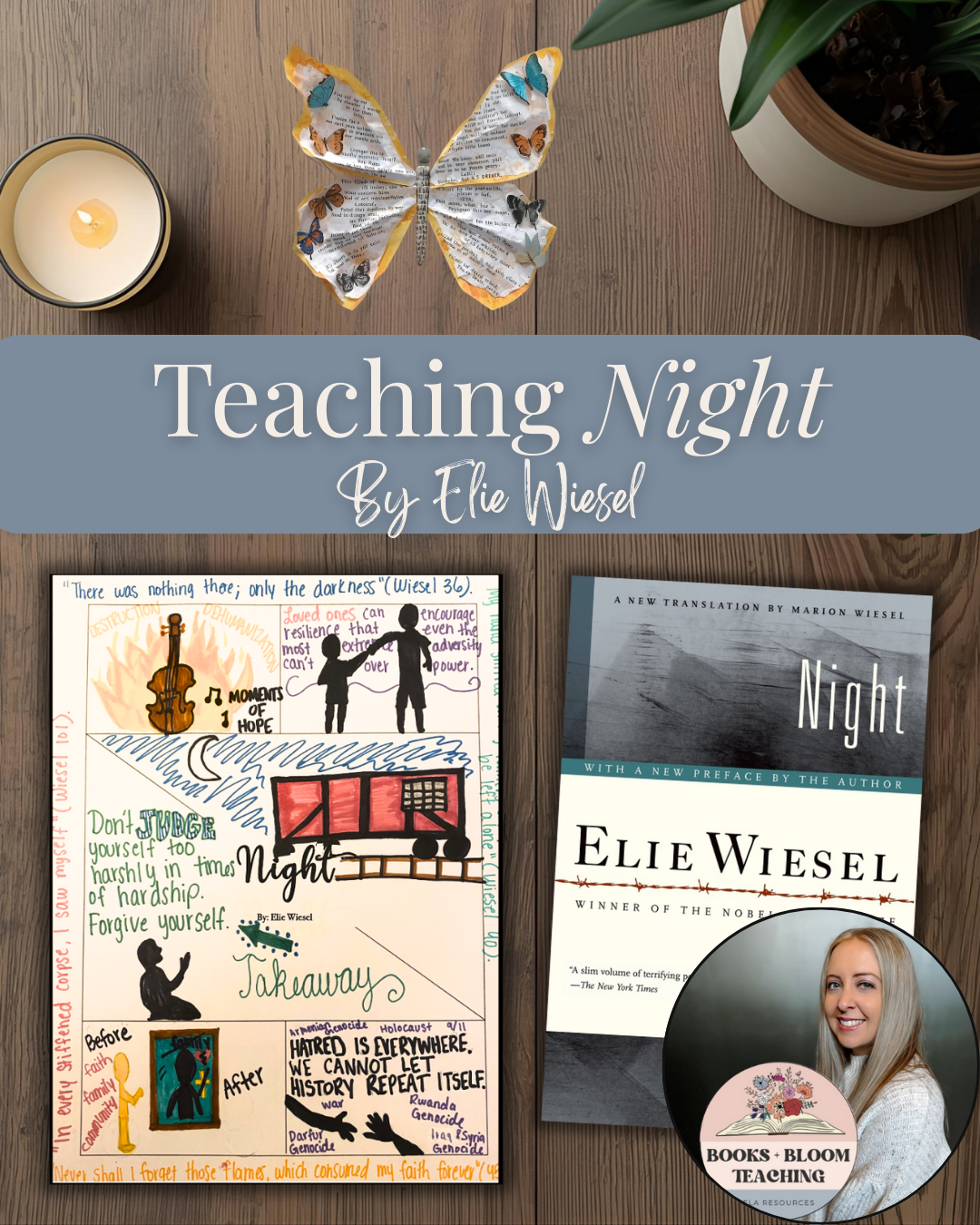
Teaching Night by Elie Wiesel is one of the most meaningful parts of my school year and one of the heaviest. Every time I teach this memoir, I’m reminded that our role as English teachers goes far beyond analyzing symbolism or assigning essays. We’re helping students confront history, reflect deeply, and think critically about humanity, injustice, and the power of bearing witness.
But here’s the challenge:
We want our Night activities to be engaging, thoughtful, and age-appropriate… while also honoring the emotional weight of the text. Over the years, I’ve refined my Night unit to include activities that do all of that (and still hit the standards).
Below are my favorite meaningful, student-centered activities for teaching Night by Elie Wiesel. These ideas help students build background knowledge, analyze themes, make personal connections, and reflect with empathy.
1. The Poetic Butterfly Project

The Poetic Butterfly Project is one of the most reflective and memorable activities I use in my Holocaust literature unit. Inspired by The Butterfly Project and the poems from I Never Saw Another Butterfly, students honor the 1.5 million Jewish children lost in the Holocaust through poetry, symbolism, and art.
How the Project Works
Part 1: Holocaust Poetry Analysis
Students rotate through six poems written by child victims of the Holocaust. Using a guided analysis handout, they read closely, choose three to analyze, and then select the poem that resonates most. This builds essential ELA skills like close reading, theme, tone, and textual analysis—perfect for any Night or Holocaust novel study.
Part 2: Symbolic Butterfly Creation & Reflection
Students design a symbolic butterfly honoring the child poet. Their butterfly includes:
- The poem’s title and author
- 2–3 meaningful lines
- Three symbolic drawings
- Key biographical details
- More!
They finish with a one-page reflection to connect their symbolism and deepen their understanding of Holocaust themes.
If you want an activity that genuinely helps students connect with Night, this Poetic Butterfly Project is it. The butterflies they create are always stunning. You’ll be blown away by their insight and creativity.
2. Holocaust Background Learning Stations

Students cannot fully understand Night without the historical, social, and emotional context of the Holocaust. However, as an ELA teacher, how deep into history do we need to go? It can be overwhelming going down that rabbit hole. Instead of front-loading with a long lecture, I use Holocaust Learning Stations that let students explore at their own pace.
My learning stations include:
- Survivor testimony
- Literature and poetry
- Propaganda & dehumanization
- Historical timeline
- Righteous Among the Nations
- Background on Night and Elie Wiesel
Students move, read, discuss, and interact with the material, making this heavy content more digestible and meaningful.
3. Holocaust Museum Virtual Tour & Webquest

The U.S. Holocaust Memorial Museum has a powerful virtual exhibit, and my students complete an engaging Webquest as they explore.
I set up eight “checkpoints,” each with guiding questions that connect directly to themes from Night. After the tour, students complete a one-page Elie Wiesel Webquest to learn about his life, activism, and legacy.
This Holocaust Museum Virtual Tour & Webquest activity gives students a meaningful, independent way to explore the museum you wish you could take them to in person. It’s thoughtful, engaging, and always eye-opening for students.
4. Theme & Quote Gallery Walk

One of my favorite days in this unit is the Theme & Quote Gallery Walk. I post eight powerful quotes from Night around the room. Students rotate in small groups, reflect on each quote, and generate possible themes.
A few reasons this works so well:
- It gets them up and moving
- It sparks great discussions
- It helps them identify themes before we analyze the whole text
- It builds buy-in for some of the book’s hardest moments
This activity is a low-prep, high-impact way to help students dive deeper into Wiesel’s message.
5. Creative One-Pager Activity

When teaching a text as emotionally heavy as Night, students often need a creative outlet that still pushes critical thinking. That’s why I love assigning a One-Pager at the end of the memoir.
Students must synthesize big ideas into a single, meaningful page using:
- Key quotes
- Themes
- Symbolism
- Imagery
- Visual interpretation
- Personal reflection
Every time, the results blow me away. These one-pagers are always beautiful, heartfelt, and demonstrate real understanding, not just of the book, but of its weight and importance.
Final Thoughts: Teaching Night with Empathy and Purpose
Teaching Night by Elie Wiesel is more than a novel study. It’s a responsibility. Our students deserve lessons that are:
- thoughtful
- trauma-informed
- student-centered
- historically accurate
- emotionally aware
These activities have transformed my Night unit into one of the most meaningful parts of the year. Not just for students, but for me.
If you’re looking for ready-made, classroom-tested materials to elevate your Night unit, I’ve linked my most-loved resources above. My complete Night unit has everything in one place and truly has it all.
If no one has reminded you lately, the work you’re doing by teaching this novel is meaningful and deeply important. You’re doing an amazing job!
Leave a Reply